Skip to content

Edinburgh

Thermal imaging surveys in Edinburgh

Our survey method: when a thermal imaging survey is doneA timeline of one day and night. Our survey window starts 1 to 2 hours after sunset and ends at sunrise. Below it, a wall with the inside at least 10 °C warmer than the outside. Inside Outside
  1. 1Day: sun warms the fabric
  2. 2Sunset
  3. 3Wait 1 to 2 hours
  4. 4Survey window
  5. 5Sunrise
  6. 6Inside at least 10 °C warmer than outside
We survey 1 to 2 hours after sunset or before sunrise, so the sun has not warmed the fabric, with the inside at least 10 °C warmer than the outside. Sunset and sunrise move with the season, so the drawing gives no clock times and is not to scale.
A thermal imaging survey of an Edinburgh building shows where heat escapes and which surfaces run cold, without opening up the fabric. For listed buildings, tenement flats and housing blocks in Edinburgh we survey inside with a handheld thermal camera and outside by drone where a flight is possible, and you get thermal and visible images side by side with a written report. At Kirkgate Tower, one visit for The City of Edinburgh Council's energy study included a thermographic survey of the building fabric. Kanna Spatial is based in Glasgow. We travel from Glasgow and are in Edinburgh most weeks.

Last reviewed . Last changed .

At a glance

Travel
From Glasgow, most weeks
You get
Thermal and visible images side by side, with a written report of findings
Methods
Handheld inside, and by drone where a flight is possible

What makes an Edinburgh building harder to read with a thermal camera?

Around 6 in 10 Edinburgh households live in flats, and over 40% of homes were built before 1945. For most Edinburgh households, then, home is a flat in a shared building.

That shapes what a thermal image can show. The flat next door may be heated differently, or not at all, and a thermal camera needs a temperature difference to work with: Historic Environment Scotland notes that it is not useful where everything is at a similar temperature, as in an unheated building. On the outside of a tall block, the upper storeys under a clear sky read colder than the floors below without performing any worse. Windows are worth a separate look too: Historic Environment Scotland’s retrofit guide uses a thermal image to show the reduced heat loss through a shuttered window.

What any thermal image can and cannot show is set out on our thermal imaging survey page. A thermal image is not a scaled drawing: for plans, elevations and sections, see measured building surveys in Edinburgh.

Winter evenings and mornings in Edinburgh

The sun sets earliest in Edinburgh at 15:38, in mid December, and rises latest at 08:44, around New Year (US Naval Observatory times, GMT). Our method starts the outside work one to two hours after sunset, or before sunrise, so a midwinter survey can be an evening visit that starts before six or an early morning one. At the Met Office station at Gogarbank, Edinburgh, the average overnight low is about 1.4 to 1.6 °C from December to February (1991 to 2020).

Inside an airport's Flight Restriction Zone a flight needs permission from the airport's air traffic control, or from the airport when air traffic control is closed, and they can say no. A drone thermal flight inside Edinburgh Airport’s zone needs that permission at night too, because the zone is active 24 hours a day. Whether an address is inside it is checked for every job, and the other limits on flying are set out under when we cannot fly.

Travelling from Glasgow for an evening survey

We travel from our Glasgow studio and are in Edinburgh most weeks. A heat loss survey from outside means an evening or an early morning visit, and we agree the date with you when we quote.

What Historic Environment Scotland's guide advises

Historic Environment Scotland’s Short Guide 10 suggests, as a rough rule of thumb, heating a building to at least 10 °C above the outside air for at least 24 hours before a heat loss survey. The guide, Thermal Imaging in the Historic Environment (2015), explains that a solid masonry wall can take a long time to warm through.

Historic buildings should not be overheated to get a better image: heat-sensitive finishes can be damaged. The guide also warns that thermal images can easily be misinterpreted.

Conditions

The conditions we survey in

Our own survey method.

Temperature difference
At least 10 °C
Heating
On for at least 12 hours where possible
Time
1 to 2 hours after sunset, or before sunrise
Rain
None
Wind
Under 5 m/s
Stability
Steady air temperatures

If the conditions are not right on the night, we move the date.

Proof

Projects we can show you

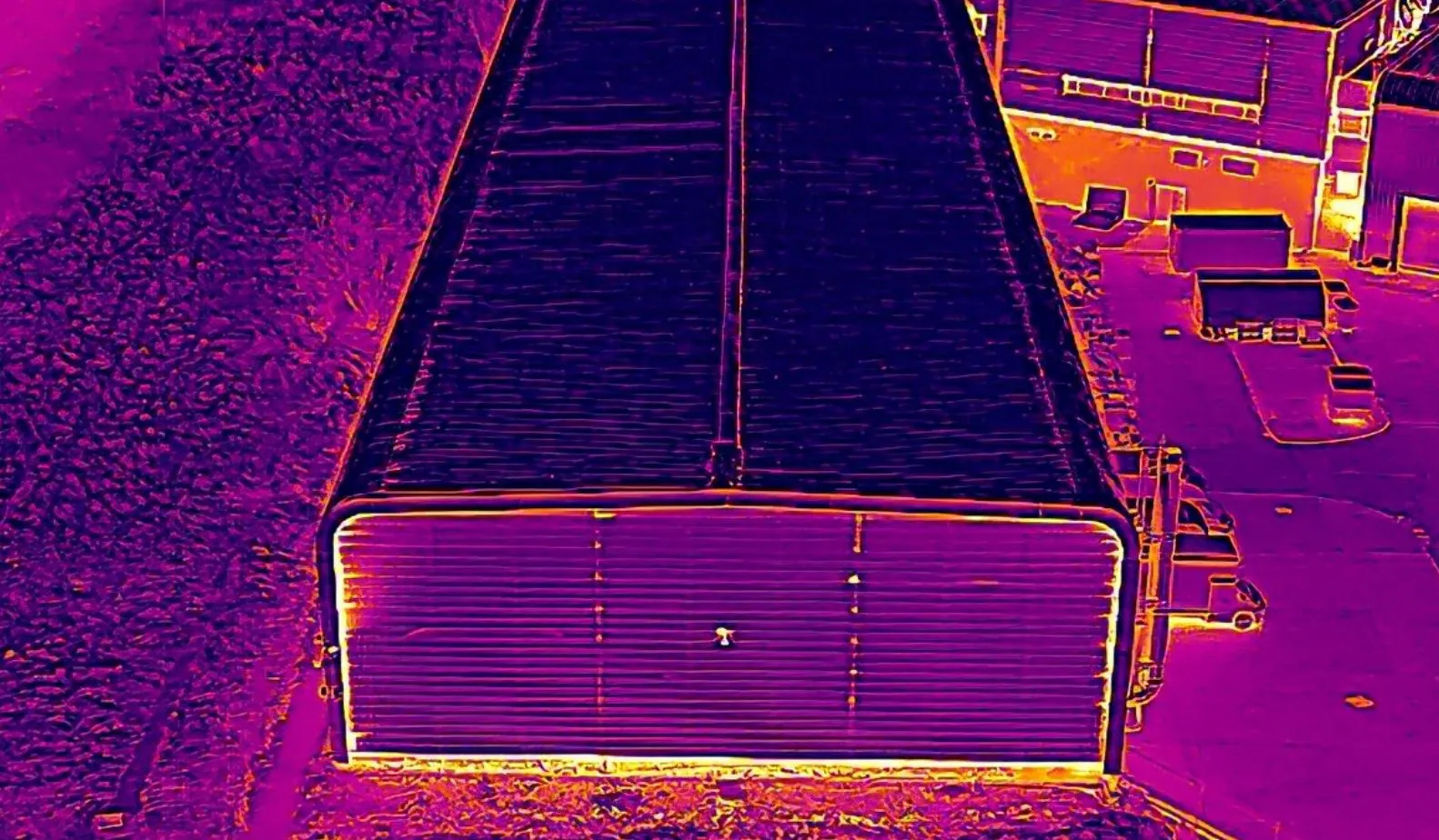
  • Drone thermal image of the roof of Glasgow Museums Resource Centre
    Drone thermal image of the roof. Glasgow Museums Resource Centre.

    A thermal image shows surface temperature only. Shiny metal and glass mostly show reflections, so spot readings on them are unreliable.

    Drone thermal imaging Thermal imaging surveys

    Glasgow Museums Resource Centre: drone thermal survey

    Drone thermographic survey of the Glasgow Museums Resource Centre with Collective Architecture, as part of an energy study of the museum store.

    Glasgow

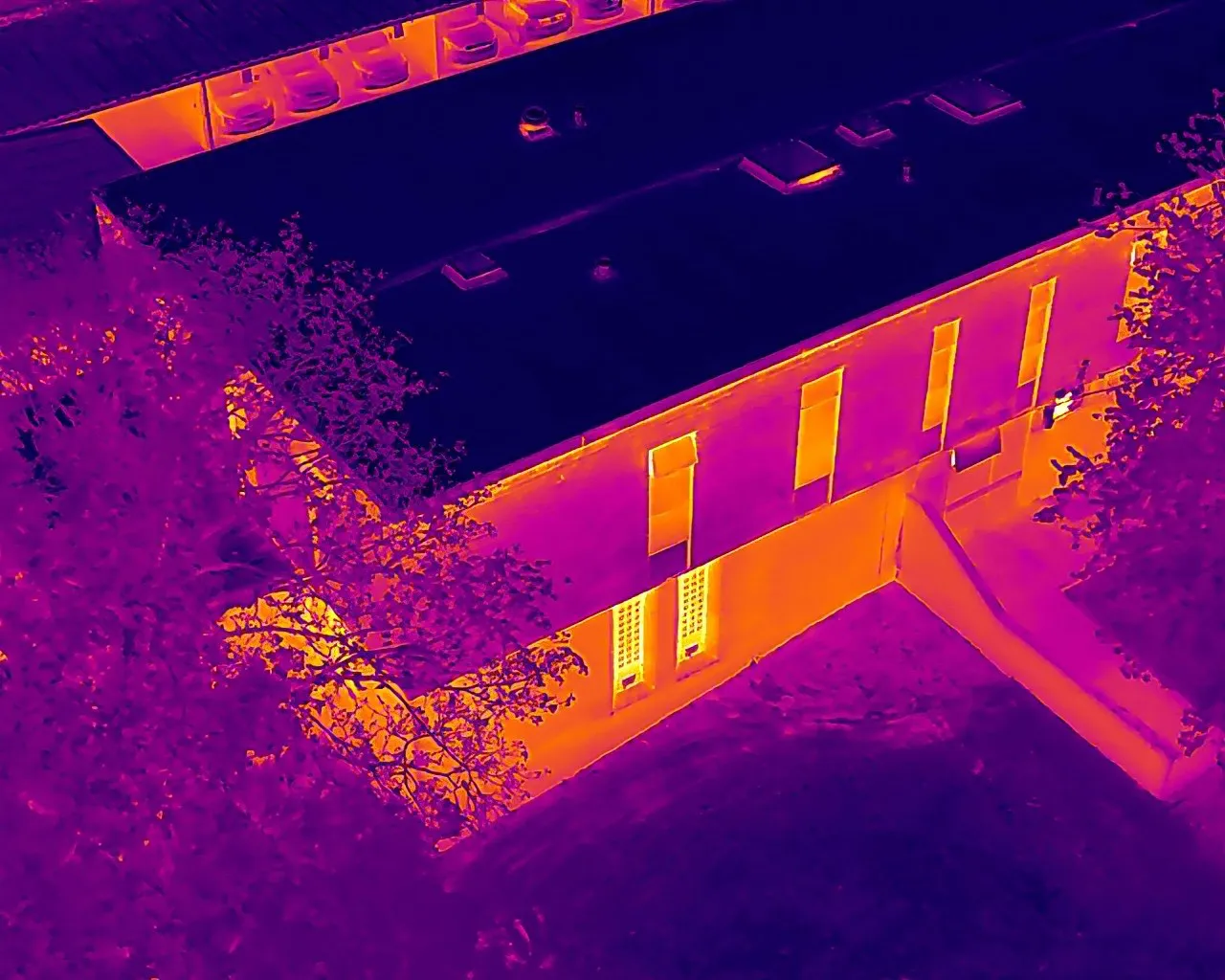
  • Aerial thermal image of Bridgnorth Police Station: the roof reads dark, the windows and wall heads bright
    Drone thermal image. Bridgnorth Police Station.

    A thermal image shows surface temperature only. Shiny metal and glass mostly show reflections, so spot readings on them are unreliable.

    Thermal imaging surveys Drone thermal imaging

    Thermographic survey of Bridgnorth Police Station

    Internal and drone thermographic survey of a Shropshire police station, locating heat loss across the roof, elevations and rooms of a working building.

    Bridgnorth, Shropshire

Kirkgate Tower is in Edinburgh. Its case study shows the 3D tour but no thermal images: the thermal images on these cards are from Glasgow Museums Resource Centre, in Glasgow, and Bridgnorth Police Station, in Shropshire.

All case studies
Where Kanna Spatial works: Scotland, measured from GlasgowA simplified outline of Scotland with Glasgow marked as the base, Edinburgh marked, and Stirling, Perth, Dundee, Aberdeen, Inverness and Onich shown for reference. Three rings show 50, 100 and 200 kilometres from the centre of Glasgow in a straight line.
  1. 1Glasgow
  2. 2Edinburgh
  3. 3Stirling
  4. 4Perth
  5. 5Dundee
  6. 6Aberdeen
  7. 7Inverness
  8. 8Onich

Glasgow and Edinburgh most weeks, across Scotland weekly, and anywhere in the UK for larger projects.

Get a price

Get a fixed price, usually the same working day

Send the address and what you need. No call needed: we reply with a price and a survey date.

What happens next

  1. 01We reply with a fixed price, usually the same working day.
  2. 02We agree a survey date.
  3. 03You receive everything in your client portal.

Prefer email? studio@kannaspatial.co.uk

What do you need?

Questions

Questions about thermal imaging surveys in Edinburgh

Can thermal imaging be used on a listed building in Edinburgh?

Yes. The camera reads the building from a distance and nothing is fixed to it or taken from it, so listed fabric is not disturbed. What needs agreeing for a listed interior is the heating beforehand, which the next question covers.

Can a thermal survey harm a historic interior?

The camera cannot: it only reads the surface. The risk is in heating a room too hard beforehand. Historic Environment Scotland gives a painted timber ceiling as an example of a finish that can be damaged if the air is too hot or too dry, and warns that gas heaters add a lot of water vapour to the air. Its advice is to work with the heating that can reasonably be achieved. Tell us about any heat-sensitive finishes when you ask for a price.

Is Edinburgh too windy for a winter thermal survey?

Some nights are. Late winter is the windiest time of year at the Met Office station near Edinburgh, and the winter average there is close to 5 m/s, so a survey date can move if the night is too windy. At Gogarbank the monthly average is about 4.8 to 4.9 m/s from January to March, against about 4.2 m/s over the whole year (Met Office, 1991 to 2020).

What did you do at Kirkgate Tower?

The Kirkgate Tower job served an energy study for The City of Edinburgh Council. One mobilisation covered three jobs: a Matterport capture of the building, volume and area calculations from the scan data for the energy study, and a thermographic survey of the building fabric. The deliverables included thermographic imagery of the building fabric, and the point cloud from the capture went to the project architect. The Kirkgate Tower case study has the 3D tour.

Can you survey a top floor tenement flat in Edinburgh under a cupola or a flat roof?

Yes. Inside, the flat is surveyed with the handheld camera. Where a cupola is glazed, glass gives sharp mirror-like reflections, often of the cold sky, so spot readings on it are unreliable. A flat roof above the flat is seen from the air, where a flight is possible. From outside, the top storeys of a tall building under a clear sky read colder than the floors below without performing any worse, so the top floor is read with that in mind.

Can a thermal survey inform the retrofit of a traditional Edinburgh building?

It shows where to look: which walls, windows and roof areas run cold. It does not measure U-values. Historic Environment Scotland advises that U-values estimated from thermal images are indicative only. Its retrofit guide also mentions a thermal camera as a way to check that blown insulation has filled the voids. Our guide to thermal imaging of tenements and sandstone buildings goes further.

Who tells residents about a night survey of an Edinburgh block?

We agree that with you before the survey. The outside work is done after dark or before sunrise, so it helps if the people in the block know when to expect a camera outside or a drone overhead.

Send the address and what you need. We reply with a fixed price, usually the same working day.

Get a fixed price Email