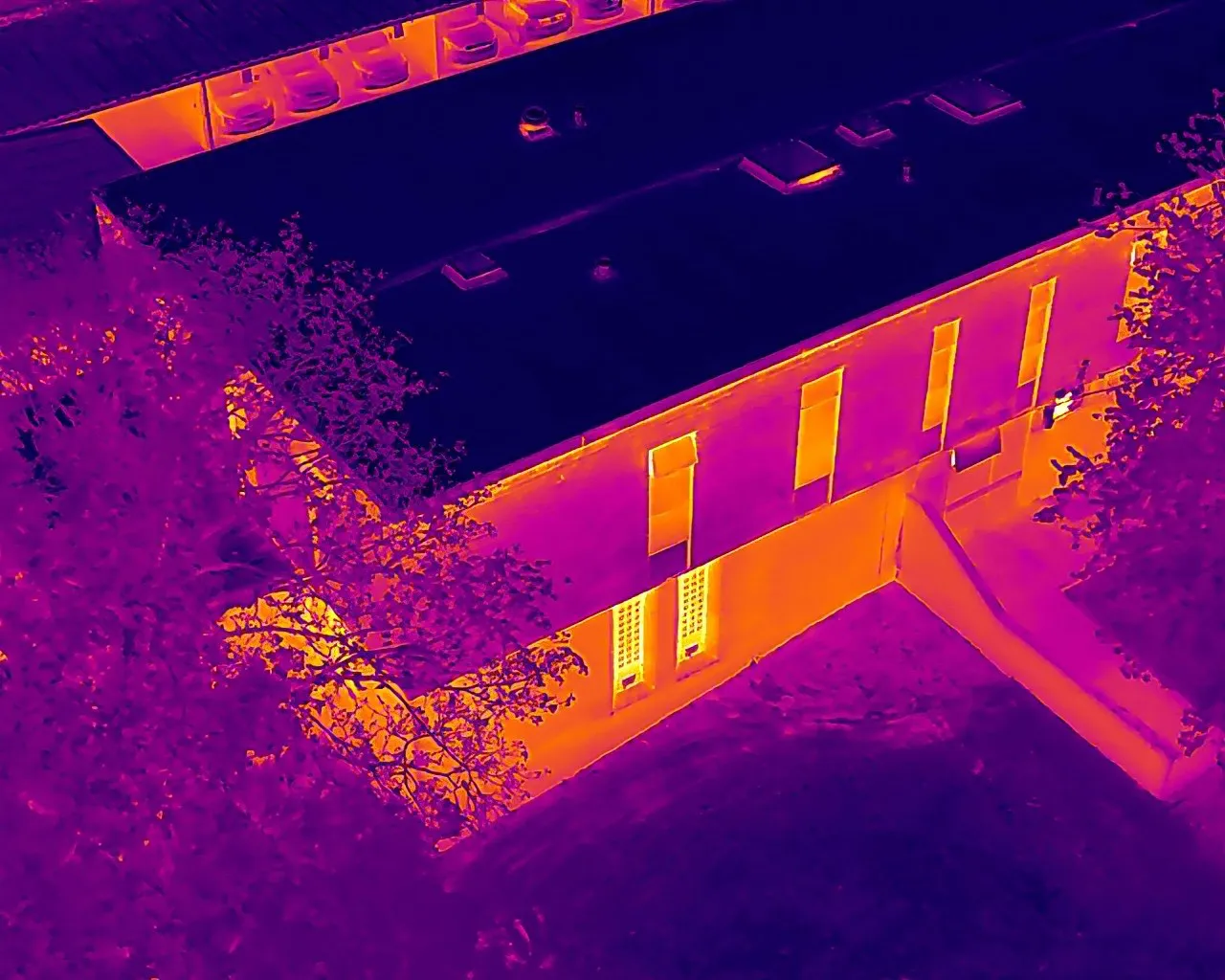
Why does a thermal survey need a cold, dry, calm night?
Heat escaping through a wall only shows on a thermal camera when the inside of the building is a good deal warmer than the outside. So the building has to be heated and the air outside has to be cold. Historic Environment Scotland (HES), in its Short Guide 10, asks for a building heated to at least 10 °C above the outside air for the clearest results, and says a more sensitive camera may give useful results with a smaller difference.
HES describes the ideal weather as cold, dry, overcast, windless and stable. Here is why the weather matters, in its terms:
- Wind. Wind chills surfaces and hides defects. HES says outdoor results will be poor if the wind gusts over about 10 m/s, and that wind should ideally be under about 5 m/s.
- Rain and wet walls. A damp surface is cooled by evaporation, so it can read cold for reasons that have nothing to do with heat loss. HES expects large errors in heat loss work when surfaces are damp.
- Sun. A wall warmed by the sun holds that heat for several hours. HES says external heat loss imaging is done in darkness, and that the ideal time is early morning, before sunrise.
- Clear sky. To the camera a clear sky can be about minus 40 to minus 60 °C, against about 0 °C for cloud, and surfaces reflect it. Glass gives mirror-like reflections, often of the cold sky, and polished metal has a low emissivity, so the camera mostly sees reflections on it. HES says an overcast day may give more accurate results.
What published guidance says
Two published sources give figures for heating and conditions. Each row is that source’s own advice, under its own name.
| Source | What it says |
|---|
| Historic Environment Scotland, Short Guide 10: Thermal Imaging in the Historic Environment (2015) | As a rough rule of thumb, heat the building to at least 10 °C above the outside air for at least 24 hours, or at least overnight, before a heat loss survey. Take external images in darkness, before sunrise. Wind should ideally be under about 5 m/s. |
| A RICS Built Environment Journal article (28 October 2021) by a practising thermographer, which is a member’s article and not RICS guidance | Keep the inside at a constant 20 to 22 °C for at least 72 hours before inspection. |
Which months are best for a survey in Scotland?
The sources describe the season in their own words, and there is no single official season:
- HES: in the UK, heat loss thermography is carried out almost entirely in the winter months.
- The RICS journal article: typically from late October to March or April.
- The United Kingdom Thermography Association: a cold, dry morning before sunlight warms the building, which in the UK typically means between September and May.
Read together, they put the season at roughly autumn to spring.
Met Office figures for central Scotland show why. The table uses the 1991 to 2020 averages for five stations near Glasgow and Edinburgh: Bishopton, Springburn, Paisley, Gogarbank and the Royal Botanic Garden. The last column sets the average overnight low against a room heated to about 20 °C. It is our own arithmetic from the averages, not a published rule.
| Months | Average overnight low | Inside to outside difference on a typical night, by dawn |
|---|
| November to March | About 1.3 to 4.2 °C | About 16 to 19 °C |
| April and October | About 4 to 7 °C | About 13 to 16 °C. Early evenings on mild days can be close to 10 °C |
| May | About 6.5 to 7.4 °C | About 12.5 to 13.5 °C, but evenings stay mild for longer and nights are short |
| June and September | About 9.1 to 10.3 °C | About 10 °C, which is marginal |
| July and August | About 10.9 to 12.1 °C | Usually under 10 °C |
From November to March the average daily maximum also stays under 10 °C at all five stations, so even the warmest part of an average day is cool. Averages hide the spread from one night to the next. A cold spell can make a summer survey possible, and a mild, cloudy winter night can still work.
How should the building be prepared?
- Keep the heating on. Our own method asks for at least 12 hours beforehand where possible.
- Move furniture early. If furniture, pictures or wall coverings have to come away from the walls to be imaged, HES advises moving them at least 6 hours before the survey, so the surfaces have time to settle.
- Do not overheat an older building. HES warns against turning the heating up in a historic interior to get a bigger temperature difference: heat-sensitive finishes such as painted timber ceilings can be damaged, and gas heaters raise the humidity. It advises accepting the heating that can reasonably be achieved. It also notes that thick solid masonry can take a long time to warm through. Our guide to thermal imaging of tenements and sandstone buildings covers what thick stone walls mean for a survey.
- Tell us what matters. Say which rooms and elevations you want imaged and what you want to find out, and we agree the scope with the quote.
What this guide cannot tell you
Whether a particular night will work. The table above is built from averages, and a survey depends on the wind, the rain and the temperature on the night itself, which a forecast weeks ahead cannot settle. That is why no date can be promised far in advance. This guide also does not explain what the images show.
How Kanna Spatial does it
Kanna Spatial surveys buildings with a handheld thermal camera, inside and outside, and by drone from the air. Our own survey method asks for a difference of at least 10 °C between inside and outside, with the heating running for at least 12 hours beforehand where possible. We survey 1 to 2 hours after sunset or before sunrise, so the sun has not warmed the fabric, with no rain and wind under 5 m/s. During the survey the outside air should stay steady within about 5 °C and the inside within about 2 °C. If the conditions are not right on the night, we move the date.
At Bridgnorth Police Station we surveyed inside and outside on the same visit, around the people using the building. Every job is quoted at a fixed price before we attend, usually the same working day. Send us the address and what you want to find out.