Damp and mould in Scottish rented homes: the 2026 investigation timescales and where thermal imaging helps
In short
Since 6 October 2026, Scottish social and private landlords who learn that a rented home may have damp or mould must have it investigated within 10 working days, give the tenant a written summary within 3 working days of the investigation and start any required repair within 5 working days. Thermal imaging can support the investigation, not replace it.
By Connor Milton MCIAT, Chartered Architectural TechnologistPublished Last reviewed 8 minute read
What do the 2026 damp and mould regulations require?
The rules are in the Investigation and Commencement of Repair (Scotland) Regulations 2026 (SSI 2026/173), made on 24 March 2026 and in force since 6 October 2026. They apply when a landlord is told by the tenant, or otherwise becomes aware, that a rented home is or may be affected by damp or mould. From then on:
Investigation. It must be completed within 10 working days, beginning with the day after the landlord is told or becomes aware.
Written summary. The tenant must be given a written summary of the results within 3 working days, beginning with the day after the investigation is completed.
Repair started. Where the investigation finds that work is needed, it must be started within 5 working days, beginning with the day after the investigation is completed.
Repair finished. In a social home, a repair of substantial damp or mould must be completed within 20 working days, counted from the first working day after it is started. The regulations set no fixed period for a private landlord to finish the work.
Which landlords and homes do the rules cover?
Both private and social landlords. For private landlords the duty sits in the repairing standard of the Housing (Scotland) Act 2006, which since 6 October 2026 also requires the house to be “substantially free from damp and mould”. For social landlords it sits in the Right to Repair scheme, which covers Scottish secure and short Scottish secure tenancies.
Scottish Government guidance lists what the repairing standard leaves out, including tenancies excluded by section 12(1) of the 2006 Act, occupancy arrangements and mobile homes.
The new wording is not limited to rising or penetrating damp, which is how the tolerable standard puts it. The guidance says the rules apply to all types of damp: rising, penetrating, condensation and traumatic.
When does the clock start?
On the day after the landlord is told, or otherwise becomes aware, that the home is or may be affected. A tenant’s report is one route. The guidance gives others, such as a routine inspection, a separate repair or a report from a contractor. It also says that sensor readings and alerts do not confirm that damp or mould is actually present.
For private lets, working days leave out Saturdays, Sundays and bank holidays in Scotland. The Right to Repair regulations for social homes have their own definition of a working day, which as made in 2002 also leaves out days such as Christmas Eve, Good Friday and local holidays when the landlord’s office is closed.
Who can carry out the investigation?
The regulations ask for a “competent person”: someone who, in the reasonable opinion of the landlord, has the skills and experience to make the decisions the investigation calls for. For a private let, that is whether the home is substantially free from damp and mould and, if not, whether work is needed. For a social home, it is whether a qualifying repair is required. The judgement is the landlord’s.
Scottish Government guidance says no specific qualifications are required. It suggests landlords look for experience of inspecting or treating damp or mould, a background in building surveying, housing maintenance, environmental health, construction, property inspection or related fields, and an understanding of Scotland’s housing standards. It names CIBSE, the Property Care Association and RICS as examples of sources and directories, and says it does not endorse or recommend particular organisations.
The guidance expects the investigation to be done in person unless another method is justified, because a visit can pick up issues that photographs or the tenant’s own report can miss. Where finding the cause needs several visits or specialists that cannot fit within the 10 working days, it says this may count as exceptional circumstances.
What must the written summary say?
Scottish Government guidance says the summary need not be exhaustive, but it must include:
the name of the person or organisation who investigated
the process and the findings, with an explicit statement of whether the home is substantially free from damp and mould
any repair carried out during the visit
where substantial damp or mould is found, the work needed and a target time for starting it
where it is not, the reasons
The 3 working days run to when the summary is issued, not when the tenant receives it. Annex C of the guidance is an example summary.
What if a deadline cannot be met?
If circumstances beyond the landlord’s control stop it completing the investigation or starting the work in time, the regulations require it to tell the tenant that it cannot comply, why, and when it expects to. Until then it must take reasonable steps, where practicable, to minimise how far the home is affected by damp or mould. For social landlords the period is suspended while those circumstances last.
How are the rules enforced?
Private tenants can apply to the First-tier Tribunal for Scotland (Housing and Property Chamber), which must now have regard to whether the landlord met the new duties to investigate and to start the work. Social tenants are owed compensation, set and capped by the regulations, if the investigation or the start of the repair is late and the period was not suspended.
How do Scotland’s rules compare with England’s?
England has separate regulations, for social homes only. Another difference is what has to happen within 5 working days of the investigation.
Scotland
England
Law
SSI 2026/173
SI 2025/1042
In force
6 October 2026
27 October 2025
Landlords covered
Social and private
Social only
Hazards
Damp and mould
Significant damp and mould hazards, and emergency hazards. More hazards from 30 November 2026
Investigation
Within 10 working days
Within 10 working days
Written summary
Within 3 working days of the investigation
Within 3 working days of the investigation, unless the work is done within that time
Within 5 working days of the investigation
The repair is started
The safety work for a significant hazard is completed, unless the tenant is temporarily rehoused
England’s rules also give emergency hazards a 24 hour limit. An amendment made on 13 November 2026 (SI 2026/1195) adds excess cold, excess heat, domestic hygiene, falls, electrical, explosion and structural collapse hazards to England’s significant hazards from 30 November 2026.
Where does thermal imaging help?
In a heated home with colder air outside, a thermal camera shows which surfaces of walls, ceilings and window reveals run colder than the rest. Cold surfaces matter for mould, which can start before any condensation shows. Schöck, a maker of thermal break products, puts the risk at about 80% relative humidity in the air next to a surface. In a room at 20 °C and 50% relative humidity, that is a surface colder than about 12.6 °C, while condensation needs a surface below the dew point of 9.3 °C.
Historic Environment Scotland’s guide to thermal imaging says cold spots on walls are at risk of condensation and mould growth, and can point to a thermal bridge, where part of the structure carries heat out through the fabric.
For a landlord, dated thermal and visible images of the affected rooms record which surfaces ran cold on the day: one piece of evidence that the person investigating can weigh with their own inspection. Neither the regulations nor the guidance chapters on the investigation and the written summary mention thermal imaging.
What can a thermal image not show?
Historic Environment Scotland’s guide sets out the limits:
The cause on its own. Thermography can often show whether a wall is wet, but the image alone cannot tell rain getting in from a leaking pipe or condensation. Finding the source usually needs more checks, such as moisture sensors, the plans or a look at the other side of the wall.
Damp in every case. Wet surfaces often read cooler, but water held deeper in a wall can read warmer, and when the air is cold and humid, damp may not show at all.
Damp as opposed to a cold detail. A cold area caused by moisture can look very like one with a structural cause.
Anything below the surface. The camera reads the surface only.
It also needs a temperature difference, so in mild weather a survey may not be possible.
What this guide cannot tell you
This guide is information, not legal advice. It summarises the regulations and the Scottish Government guidance as they stood on 18 November 2026. It cannot tell you whether a particular home is substantially free from damp and mould, who should investigate it, or what a tribunal would decide. For a particular case, read the regulations and the guidance themselves, and take legal advice.
How Kanna Spatial does it
Kanna Spatial is a reality capture studio in Glasgow. For damp and mould, we supply evidence for the landlord’s investigation, not the investigation itself: thermal and visible images of the affected rooms side by side, taken with a handheld FLIR thermal camera, and a written report of findings and anomalies, in a private client portal the landlord can share with the person investigating. Carried out with reference to BS EN ISO 6781-1:2023.
Our own method asks for at least 10 °C between inside and outside and, where possible, the heating on for at least 12 hours beforehand, so in mild weather we may not be able to survey inside the 10 working days.
The regulations themselves do not use the name. The Scottish Government's guidance for landlords, first published on 4 September 2026, is titled 'Awaab's Law: guidance for landlords in Scotland'. Private landlords must have regard to it. Social landlords have no statutory duty to, but the Scottish Housing Regulator will have due regard to it. England's rules are separate regulations, compared in the table in this guide.
Does a landlord need a thermal imaging survey to meet the rules?
No. The regulations ask for an investigation by a person the landlord reasonably judges to have the skills and experience, and they do not mention thermal imaging. A thermal survey can give that person a dated record of which surfaces ran cold, as one input to their investigation.
Will other hazards be added to the Scottish rules?
The Scottish Government's policy note on the regulations, dated 21 January 2026, says damp and mould will be the starting point, with other qualifying hazards to be included over time. It gives no date. When we checked on 18 November 2026, legislation.gov.uk listed no later change to the regulations.
Does the Scottish Housing Regulator track damp and mould?
Yes. Social landlords report three damp and mould indicators in the Annual Return on the Charter: the average time to resolve cases by cause (condensation, structural or other), the share of resolved cases that were reopened, and open cases at the year end. Time is counted in working days from the first report until the landlord judges the work satisfactorily complete. The Regulator's review of the first year, dated 15 September 2026, found that social landlords resolved over 40,000 cases in 2025/26, taking an average of 26 days.
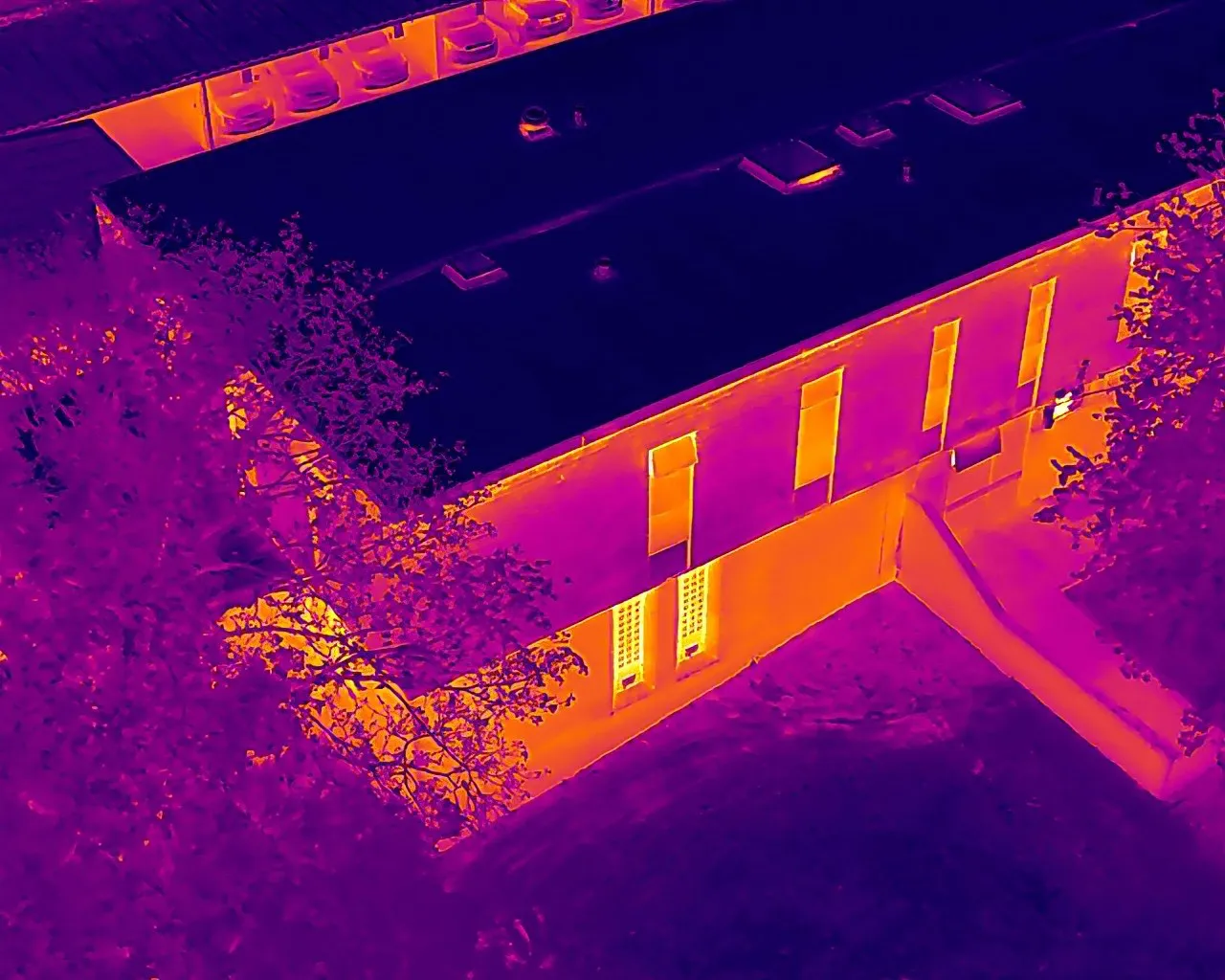
Internal and drone thermographic survey of a Shropshire police station, locating heat loss across the roof, elevations and rooms of a working building.
A thermal imaging survey uses an infrared camera to show the surface temperatures of a building, so heat loss, missing insulation, thermal bridges and the cold surfaces caused by air leakage can be seen.